What is a 'project' and what is a 'product'?
The focus of an engineering activity is about producing a product or tangible output. Sometimes, the terms 'product' and 'project' are used interchangeably, especially in engineering-type projects. This causes confusion, especially when a project is not focused on a specific product. Concepts relating to 'products' and 'product management' can become inappropriately attached to a project and influence how it is managed. We need to differentiate between the two sets of concepts.
A product is a thing, a tangible artefact that is often produced by a project. Indeed, a project can produce a range of products that might include, for example, a spares inventory and a range of documents, such as user manuals and service schedules. Some products might be less tangible, such as training events or other services that have been created to satisfy the project requirements.
-
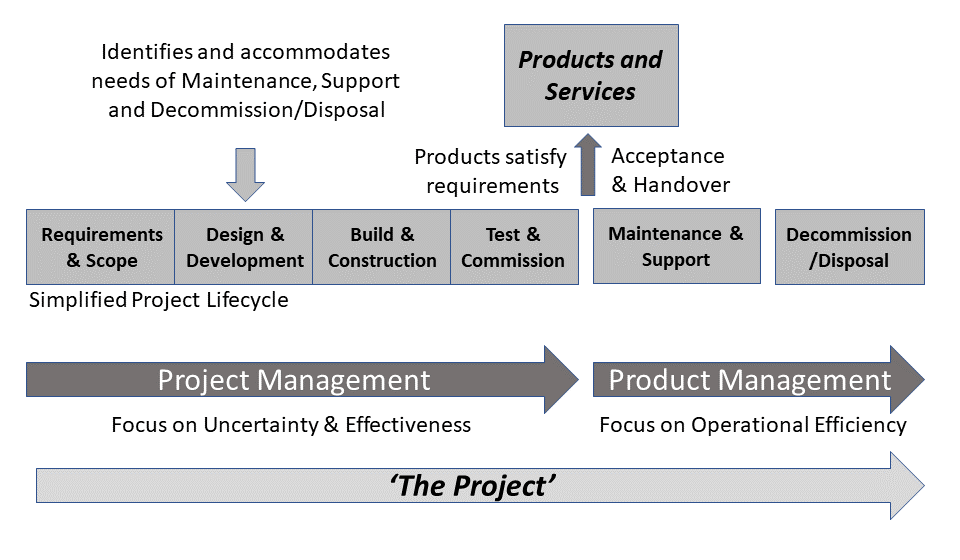 Distinguishing between Projects and Products, Project management and Product management
The figure shows that, though products and services come into being during the development and construction phases of a project, they are not 'fully formed' until successfully commissioned, subsequently accepted and transferred to the customer at handover. Project management must ensure that the maintenance, support and disposal actions are defined and realised as part of product development.
The development phases require the skills of a project manager who understands how to address:
The emphasis during development is on effectiveness - doing the job right. This might take time because of uncertainty, ambiguity and addressing the change process. It is not appropriate to expect development to be efficient.
After handover, activities such as maintenance and support that operate with much reduced ucertainty and ambiguity, can have greater emphasis on operational efficiency. These operational phases are better served by the skills of a product manager, who understands efficiency as part of a 'steady-state' operation.
It can be argued whether the decommissioning and disposal stage is a continuation of product management or if it becomes a separate project. Consideration for the project maintenance and 'end of life' are planned during design and development stages, so one view is that decommissioning is an operational task. However, if the original plan is no longer viable due to, for example, changes in legislation, then the focus involves uncertainty once again.
'The Project' refers to the whole undertaking, from start to finis, 'from cradle to grave'. How the whole project is managed requires two distinct parts that emphasise different management focus and skills. The whole project is planned, developed and commissioned through project management with emphasis on effectiveness and the support, maintenance and disposal stages require operational or product management that emphasises efficiency.